
The week beginning on 5 August was marked by significant volatility across financial markets, driven by a combination of factors outlined below:
31/07/2024
The Bank of Japan announced its second increase in the policy interest rate, raising it by 25 basis points to 0.25%. The announcement led to an appreciation of the Japanese yen and sovereign bonds and, in contrast, a sharp decline in the Japanese equity market, reflecting an apparent reduction in investors’ risk appetite.
On the same day, the U.S. Federal Reserve announced that it would keep its benchmark interest rate, the Federal Funds Rate, unchanged at 5.25%-5.50%. In addition, the Chair adopted a more cautious tone, indicating that the Federal Reserve was beginning to observe signs of a slowdown in the U.S. labour market.
These two developments are particularly relevant because of a popular investment strategy known as the carry trade, which involves borrowing in a currency with low interest rates (in this case, the Japanese yen) and investing in a currency with higher interest rates (in this case, the U.S. dollar) or in assets with greater return potential.
By this stage, most U.S. companies had already reported their second-quarter earnings. Market consensus was relatively disappointing and signs of weakness among U.S. consumers were beginning to emerge, raising questions as to whether investors’ expectations, reflected in the appreciation of risk assets, were adequately supported by fundamentals.
However, the economic data released later that week would reinforce these concerns.
02/08/2024
U.S. employment data for July showed a marked slowdown in job creation and wage growth, together with an increase in the unemployment rate to 4.30%. Overall, the figures pointed to a deterioration in the U.S. labour market and came in below analysts’ expectations.
The rise in unemployment to 4.30% also triggered the Sahm Rule. Developed by economist Claudia Sahm, this indicator suggests that an economy may be entering the early stages of a recession when the three-month moving average of the unemployment rate rises by at least 0.50 percentage points above its lowest three-month moving average over the previous twelve months.
Historically, every time this rule has been triggered, the U.S. economy has subsequently entered a recession. Based on the July data, the indicator reached 0.53 percentage points, exceeding the threshold.
This combination of factors — lower expected returns from carry trade strategies, weaker corporate earnings expectations driven by signs of consumer weakness, and the deterioration of the U.S. labour market — led to sharp declines across major financial markets and a significant increase in volatility.
Trillions of dollars in market value were wiped from major stock markets. The S&P 500 fell by approximately 5% at its lowest point, while the Nasdaq 100 experienced a similar decline.
Meanwhile, U.S. Treasury bonds rallied, pushing the yield on the 10-year Treasury down to 3.79%. This reflected a more defensive positioning by investors. Expectations for future interest rate cuts by the Federal Reserve also increased significantly, with markets pricing in a 50-basis-point cut at the September meeting.
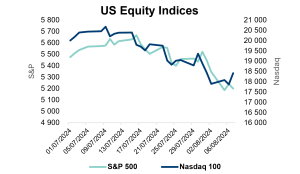
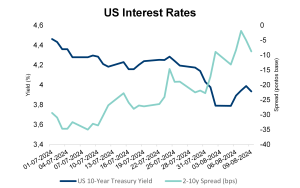
Nevertheless, some of these market movements appear to have been somewhat exaggerated. Claudia Sahm herself commented that, in her view, current labour market data do not necessarily indicate that the U.S. economy is already in recession.
Furthermore, U.S. GDP growth in the second quarter was considerably stronger than in the first quarter. With the disinflation process seemingly progressing as expected, it remains unclear whether the cycle of interest rate increases will ultimately push the U.S. economy into recession or whether the Federal Reserve will succeed in achieving a soft landing — bringing inflation back to its 2% target without triggering an economic downturn.
_________________________________________________________
This communication has been prepared by Banco Finantia for informational purposes only and does not constitute investment advice. In preparing this communication, no consideration was given to investors’ investment objectives, financial situation, or specific needs. Accordingly, the information has not been tailored to any actual or potential investor, nor have any specific circumstances relating to such investors been taken into account.
The information disclosed is based on market conditions prevailing at the time, as well as on information obtained from recognised third-party entities, which are public sources. Banco Finantia has not independently verified the data or information provided by those entities. As the recipient of this communication is aware of this situation, Banco Finantia cannot, under any circumstances, be held liable for any errors, omissions, or inaccuracies contained in this document or arising from the use of such information. Banco Finantia accepts no responsibility for any direct or indirect losses or damages that may be incurred by those who carry out transactions based on the information provided.
Banco Finantia’s investment policy, whether acting on its own account or on behalf of its clients, is entirely independent of the content of this communication. The Banco Finantia Group may hold positions in, or trade, the securities or financial instruments referred to herein, before or after the issuance of this communication, and may also provide, or seek to provide, banking services to the issuers of such securities or financial instruments.
Banco Finantia’s competent supervisory authority is the CMVM, with which it is registered under number 109.