
After months of internal conflict within the three-party coalition between Olaf Scholz’s SPD (centre-left), the environmentalist Greens and the liberal FDP, over Germany’s economic difficulties and possible solutions, the coalition finally collapsed in the first week of November. The breakdown was triggered when Scholz dismissed Finance Minister Lindner, who is also the leader of the FDP. While Scholz sought to raise taxes, increase public spending and amend the constitutionally enshrined debt brake, Lindner instead advocated cutting government spending on social welfare programmes and other areas.
In recent weeks, there has been extensive discussion about Germany’s debt brake and whether such a constraint makes sense at a time when the country’s economy is struggling to recover from the inflationary crisis that hit the region following Russia’s invasion of Ukraine.
But what exactly is the debt brake? This requirement was introduced into the German Constitution in 2009 by Angela Merkel, following the sovereign debt crisis, and legally requires the states and the federal government to limit net borrowing to a maximum of 0.35% of GDP. Since its introduction, the German parliament, or Bundestag, has voted three times to suspend the debt brake — in 2020, 2021 and 2022 — essentially during the Covid-19 crisis, followed by the energy crisis. The Constitution allows the debt brake to be suspended in cases of “natural disasters or unusual emergencies beyond the control of the government and substantially impairing the state’s financial capacity.”
It can be argued that such a strict limitation on the government’s ability to incur new debt may hinder the country’s economic growth in the coming years.
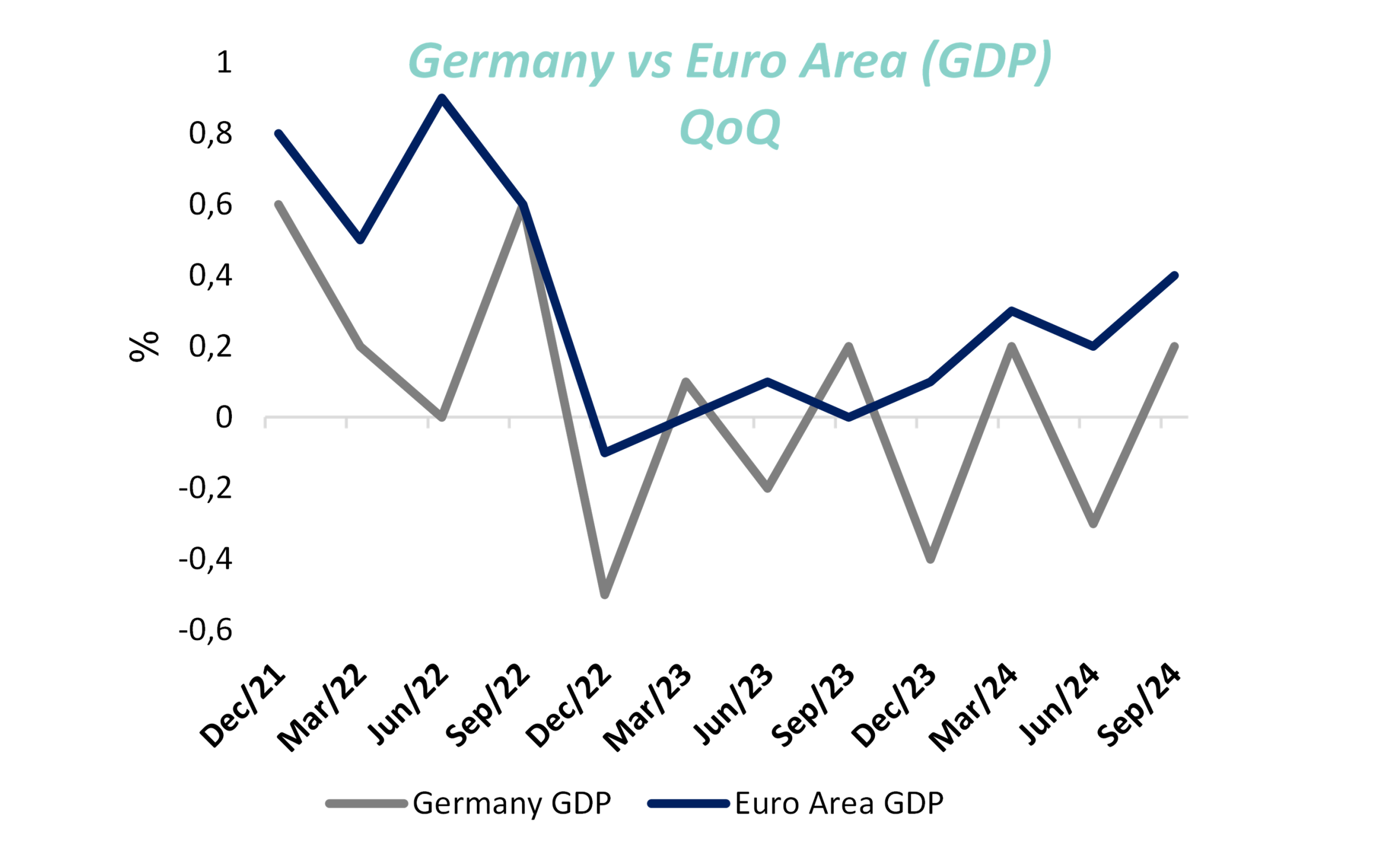
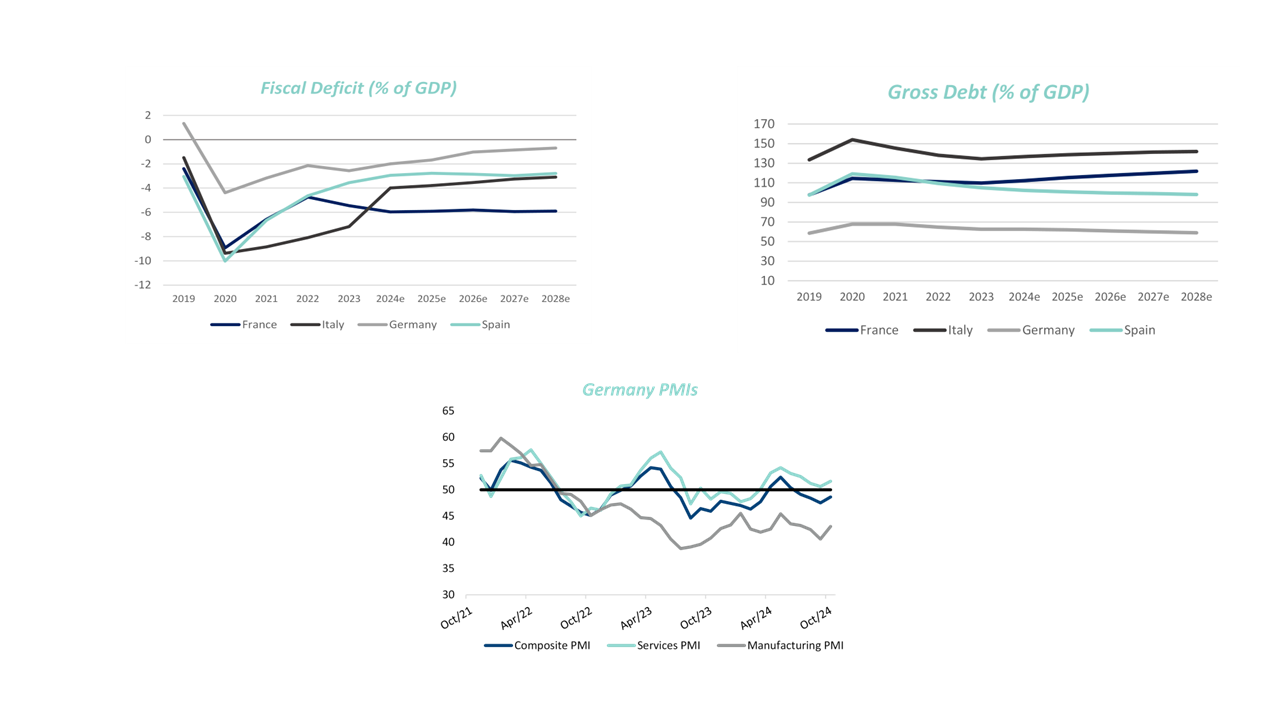
Germany’s manufacturing PMIs have remained below 50 (the threshold between contraction and expansion) since June 2022, consistently indicating a weakening sector. Despite a relatively stronger services sector (with PMIs often above 50), Composite PMIs have, for the most part, pointed to a softening business environment, ranging between 44.6 and 54.2 from June 2022 to October of this year. The economic slowdown reflected in the PMIs has translated into weak economic growth over the past two years, with Germany oscillating between modest growth and economic contraction during this period.
Despite being the slowest-growing economy among Europe’s four largest economies (Germany, France, Spain and Italy), Germany remains the most fiscally prudent, with the lowest fiscal deficits of the four. Even in times of crisis, such as in 2020, Germany’s deficit stood at 4.4%, less than half of France’s in that year. This naturally translates into Germany also having the lowest public-debt-to-GDP ratio among the four countries, never exceeding 70%, although it has been above the EU’s fiscal rule for the debt ratio in recent years (except in 2023).
Germany, once an industrial powerhouse, has been losing momentum, and the competitive advantage it once enjoyed is fading in the face of faster-growing economies with much cheaper labour forces, such as China. As a result, a serious reform of the country’s public finances is increasingly becoming a necessity rather than an option.
The political collapse occurred one day after Donald Trump won the U.S. election. For several months, Trump has threatened to impose 10% tariffs on all imports. The United States is one of Germany’s most important trading partners, accounting for around 10% of the country’s exports. Bundesbank President Joachim Nagel estimated that the potential impact of Trump’s tariffs would be equivalent to 1% of the country’s GDP. Nagel added that the German economy is not expected to grow this year and will likely grow by less than 1% next year: “If the new tariffs are actually imposed, we could enter negative territory.”
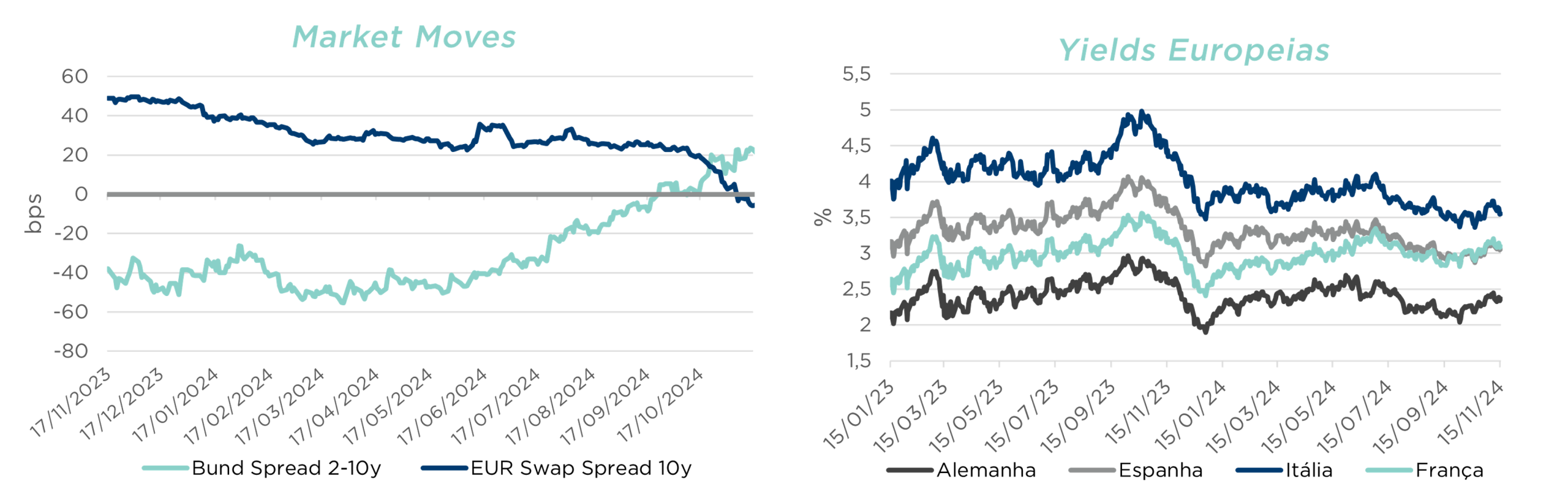
Investors appear to have taken on board the weakening outlook for the region’s largest economy and, following the political turmoil, markets reassessed the country’s risk perception. However, Bunds continue to be used as the region’s risk-free benchmark. For the first time on record, the EUR 10-year swap–Bund spread moved into negative territory on 7 November, reflecting a higher perceived risk for Germany relative to the Euro Area, and has continued to widen since then. In addition, the Bund yield curve has steepened, also signalling increased risk as well as expectations of interest rate cuts by the ECB.
In summary, the German economy has shown signs of being in need of reinvention; however, political instability (with a confidence vote in the Bundestag scheduled for 16 December and elections on 23 February), constitutional budgetary constraints, and external threats such as an impending trade war could certainly hinder that process.
_____________________________________________________________________________________________________________________________________
This communication has been produced by Banco Finantia for informational purposes only and does not constitute investment advice. In preparing this communication, no consideration was given to investors’ investment goals, financial situations, or specific needs. Accordingly, the information has not been tailored to any actual or potential investor, nor have any specific circumstances relating to such investors been taken into account.
The information disclosed is based on market conditions prevailing at the time, as well as on information obtained from recognised third-party entities, which are public sources. Banco Finantia has not independently verified the data or information provided by those entities. As the recipient of this communication is aware of this situation, Banco Finantia cannot, under any circumstances, be held liable for any errors, omissions, or inaccuracies contained in this document or arising from the use of such information. Banco Finantia accepts no responsibility for any direct or indirect losses or damages that may be incurred by those who carry out transactions based on the information provided.
Banco Finantia’s investment policy, whether acting on its own account or on behalf of its clients, is entirely independent of the content of this communication. The Banco Finantia Group may hold positions in, or trade, the securities or financial instruments referred to herein, before or after the issuance of this communication, and may also provide, or seek to provide, banking services to the issuers of such securities or financial instruments.
Banco Finantia’s competent supervisory authority is the CMVM, with which it is registered under number 109.